| becoming a self in history … becoming a self in my streetsocial sculpture by deborah ravetz
My question is: what does it mean to become a self? That is my place of engagement. I don’t have to travel to far distant places to explore my question. Rather in my own community and the circle of all the people I meet I can find the challenges and the processes I would like to understand and learn from. In this sense my community is not an ordinary or insignificant place; it is a place where an individuals potential may blossom or wither, where community can grow or not. In this sense the place where I live and the network of people with whom I connect everyday is the most important and potentially fruitful place to be. The piece is called, Becoming a self in history, becoming a self in my street. My own community is my starting point. However everything that has ever happened in the world began with a single person responding to their situation. This connection of the personal with the wider community is also something I want to make visible and explore. What I mean by this is probably best explained by telling the story of Bill Wiseman. Wiseman was the American politician who invented the lethal injection. This is now the preferred form of execution in the USA. He described his reasons for getting involved with the political situation which lead to him doing this in the following way. ‘I thought I could be very competent as a legislator. Secondly I liked the idea that it gave me an identity. I have always lived in the shadow of my father, and it would be a chance to take all these ideas I have on ethics and moral behaviour and do something about them.’ With this as his original intention Wiseman became a successful member of the Oklahoma legislature. He loved his job both for what he was able to do for his community and because he enjoyed the sense of being someone that it gave him. During his time in office the question of capital punishment became a subject of debate. At the time no politician who was opposed to the death penalty could hope to retain their seat. Wiseman was so unwilling to loose power he voted for the death penalty even though he didn’t believe in it. Furthermore, in order to assuage his conscience, he and a friend, despite both being completely unqualified, concocted the lethal injection. It was their intention to make execution as painless as possible. Ironically, removing, ‘the stench and pain’ of execution meant far more people were executed than previously. Over and over again people tried to warn Bill Wiseman this is what would happen. He said of himself at this time, ‘I must admit, staying in office became my top priority. I had an identity, a mission, and all kinds of recognition. Anything that would threaten that would strike a dark hidden terror.’ At the time I first read about Bill Wiseman in 2006 eight hundred people had been executed using the lethal injection. Bill Wiseman describes living in the shadow of his father and the dark terror he fled from in his bid to remain in power. The sense of self he got from, ’being someone‘ was so important he was not only prepared to be part of something he didn’t believe in, he was prepared to ignore countless warnings about the implications of his behaviour, to the extent that many have died and will still die as a result of it. Bill Wiseman since recanted from this position and become a dedicated member of the lobby fighting to outlaw the death penalty. He lost his seat on the Oklahoma legislature precisely because he took this stand. His first course of action was driven by his fear of his own darkness. It led him to act against his principles and cause great harm. It gave him a sense of identity but it was a phantom self, a self that led to him betraying both who he truly wanted to be and the community he was there to serve. I am interested in the phantom self that he was and the deep self he became, the self that was able to face his hidden terrors, renounce power and act out his deeper values. I am shaken by the reality of the power of our own inner struggles unchallenged and unmet and their power to cause ourselves and others harm. I am also heartened by the possibility of individuals to face those challenges and become their deeper self with all the blossoming that ensues. This process is what I mean when I say that the personal is political. It is the willingness to engage in this process, something I believe happens over and over again in a person’s life, something that can never be completed, that lies at the core of life and my search for meaning.
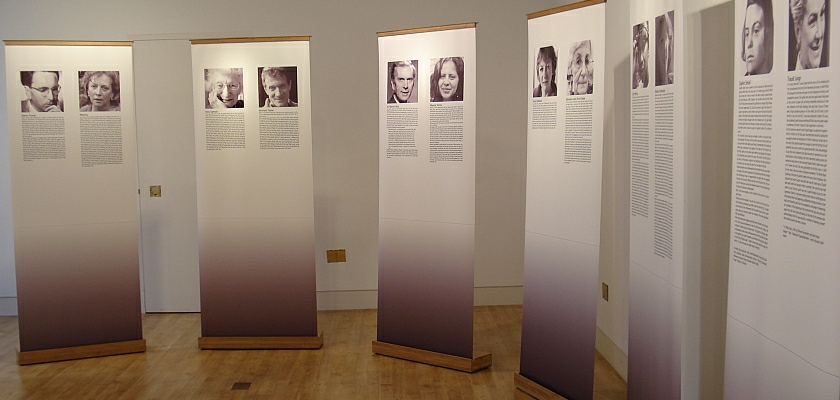
The Self-MomentsAbout the photographsWhen photographing the people for this exhibition, I am trying to pull back the layers, questioning how can I find what is true? I would like these photographs to give countenance to people’s stories. That through the words and the images it can be seen that a person’s life is a seed, a living blueprint for more becoming. Taking the photographs also gives countenance to my story, and my search for a place to explore my becoming. I know how difficult it can be to have one's photograph taken. I would like to thank all those involved for their openness to this process. Some of the portraits have been taken from other sources. Jane Chase email Michael Chase When I was fifteen years old, I was sent to a criminal juvenile institution for possessing drugs while being out of school and under age in South Africa. After having been there for a term, I ran away while being escorted by a guard to a holiday camp. As I was being chased by station guards I made my way to a nearby dual carriageway where I hid in a ditch. I thought I was safe and free. As I lay there I began to feel that rather than being safe I was actually in an abyss, a place of abandonment and isolation both inwardly and outwardly. In that dark place I realized I had a choice to make: to stay there and keep running or to go back to my prison on my own terms. I chose to go back and I recommitted myself to the institution. From that moment I began to draw. I drew faces, faces with every possible expression, the myriad selves of my soul life, both creative and destructive. This was the beginning of my journey to my present work as a mask practitioner. I walked back to my prison in order to learn that freedom was an inner quality and that it is not about doing what you like but doing what you really wish to do. I didn’t want to wreck my body with drugs or risk my life on the edge and I needed to get hold of my own inner world, to be the director of my soul, rather than driven by it. It this process that is now the central theme of my own work with masks. Viktor Frankl Viktor Frankl was a Viennese doctor who was taken by the Nazis to Auschwitz. He arrived there with his young wife and was separated from her in the selections. He had with him the manuscript of his book which was the culmination of his life’s work. On reaching the infamous shower block where prisoners were stripped, tattooed and shaved he spoke to an older prisoner asking him to help save his manuscript. With a look of mocking contempt the prisoner looked at the manuscript and uttered the word, ‘shit’. Without any softening of his words he made it quite clear to Frankl such concerns were irrelevant in a place where the only way out was through the chimney of the crematoria. Frankl was the founder of Logotherapy, which holds that it does not matter what we expect from life, but rather, what life expects from us. Our response to any situation lies in our power of choice, and in these choices the meaning of each individual existence lies. Confronted with the reality of the camp and the realization that his wife, and therefore their future, had died, he had only one choice, which was to live what he believed there, in the worst possible place. This he did. He survived the camps and spent the rest his of life working for understanding between nations as well as for the healing of the traumatized individual. The manuscript that was lost in Auschwitz was written again when he returned home. His unflinching honesty about the experience he had and his response to it gave his philosophy potency and inner authority. Vera Samuel Vera was eighty one when we spoke about her life. She was born in great poverty because her father was unemployed. She had always loved school but she herself was unable to pursue her own education and had started work when she was fifteen. At the age of thirty she was given the opportunity to attend a second chance women’s college for a year of liberal education. She described this as bliss. At the age of thirty seven she became the headmistress of a school where most of the children came from troubled backgrounds. Many years later, long after she retired, she received a letter from an ex pupil. The woman who wrote was now a social worker. She had come from a family where she had suffered severe abuse. While attending Vera’s school she had been taken away from her abusive family and had been put into foster care where she had flourished. When she was older she had looked up her own records and discovered she owed her rescue to Vera’s involvement in her plight. In a time where such words as abuse were hardly known Vera had been aware of a little girls suffering and done something to help and rescue her. That little girl now become a woman wrote to thank Vera. She went on to explain to Vera that her own experiences of abuse and the help she received had given her the inspiration to do her current job. She and Vera carried on a long correspondence after this. David Bomberg David Bomberg was a working class Jewish boy who made it to art school and believed in the ideals of modernism. He was deeply influenced by the dream of a future in which machines free us from having to work. Called up to fight in the trenches of the First World War, he witnessed unbearable carnage and got himself discharged by shooting himself in the foot. In doing this he risked being shot for cowardice. After his experiences in the trenches he suffered a severe depression. His whole view of life, his standpoint, had been called into question by the reality of war. He felt a deep need not to be abstract, but to find what one lived for out of real experience, not theories. He then rejected all the ideas of modernism, feeling that he had seen the consequences of the modern technology untamed by human values, first hand. He said: ‘We have no need to dwell on the material significance of man’s achievements…but with the approach of scientific mechanization and the submerging of individuals we have urgent need of the affirmation of his spiritual significance and his individuality.’ By speaking as he did and painting in a new way he lost credibility in the fashionable art world and lived in great poverty. Despite treading this lonely path he never compromised as he believed that art without integrity was nothing. Towards the end of his life he taught in the Borough Polytechnic in London and became known as the greatest teacher of the age by his students. He only received real recognition after his death. Annette Gordon The day after the Twin Towers had been destroyed, I had guests staying in my house who had come for the wedding of a mutual friend. We were sitting together having a meal and sharing news. I began to tell my friends about a difficult situation in my life. I had been friends with a woman who had exhausted me by extreme demands for attention. In the end I had tried to end the friendship because I felt unable to be who she needed me to be. As I talked about this my husband began to speak about what I was saying in a cold and detached way. There seemed to be no connection between what I was sharing and his response. My friends, however, tried to understand and enter my experience. I felt on the one hand invisible and on the other truly seen. I had been married for sixteen years and in that moment when I was listened to with openness by my friends I found myself thinking, ‘Life can actually be like this, I am understandable and I don’t have to always feel I can’t communicate.’ I also knew consciously, for the first time, just how lonely my marriage was. I am so puzzled that after sixteen years it was this one conversation that changed my whole life. I began to speak to my husband and ask for more connection but I was unable to inspire him to come towards me. Finally, because I couldn’t stop needing more closeness, he left and I found myself physically alone. I lost my husband and all the security of our marriage. I was very scared and at times overwhelmed. I have now moved nearer to people who share my deepest values and I have rebuilt my life from the ground up. Now I am single and I have a lot to work through as a consequence of my marriage failing but I am surrounded by people who really want to know me. I am also doing work that I really love. Before I blotted out my whole feeling life in order to survive, and in the process I lost myself. I risked everything to ask for closeness with my husband and through that I lost him. I do feel though that I found myself and that in that sense although I am still sometimes lonely it is a creative loneliness and Martin Luther King Martin Luther King told a story of how he was sitting in his kitchen late at night. The lights were all on and all of the curtains were open. He was shaken to his core because he had suddenly sensed deep in himself that if he continued in his struggles with the civil rights movement he was going to be murdered. He describes how his skin crawled and his hair prickled on his head. His mouth was dry and he felt as if his stomach was turning to water. In the throes of this shattering fear he began, gradually, to experience a new and exhilarating perspective. He suddenly knew with absolute conviction that no one could kill him. He understood they could kill his body but he had a deep realization that who he really was something independent of his body. He felt an absolute conviction that though his body could be destroyed he and his great idea could not be. In this moment he stopped fearing his death and became totally free to do exactly what he believed no matter what the consequences. Tomie Ando Tomie described being involved in a situation where she felt responsible to be a bridge-builder between two different groups. She was unable to help and the situation collapsed. Her failure to bring about harmony was a cause of deep pain and grief to her. She felt that despite the best will in the world she had been completely ineffective. For many years after these events she was depressed and lost her confidence which meant she could no longer trust herself to speak in difficult situations. A few years ago she attended a lecture held on Holocaust Memorial Day. The lecture had as its starting point the premise that such events as the Holocaust are possible through the behaviour of ordinary people just like the ones who were sitting in that audience. The speaker explored, among other things, the human problem of having a point of view and making it visible. Using art, literature and biography she described the processes which enable people to behave with integrity or not. Towards the end of the lecture she told the life story of Hans Stangl. He was a man who began life as a weaver in Austria. Through tiny self deceptions and through silence he found himself made commandant of Treblinka. The fact that these tiny moments are all within an ordinary persons grasp are what gives his story such power to command our attention; the fact that they lead him to such a dark place adds to its potency. This biography had a profound effect on Tomie’s state of paralysed silence. She realised through hearing Stangl’s story that her silence had as much potential to harm as she feared her speaking had in the past. Since that time she has been on the slow and painful journey. What she is working with now is learning how to re engage with social processes and to find appropriate silence but also the courage to speak. What she has discovered is there is no set answer and that sometimes things do go wrong but that it is always possible to learn from her mistakes and try again rather than being paralysed by a fear of making things worse. Traudl Junge In a long interview Traudl Junge told the story of her childhood and the circumstances that led to her becoming secretary to Adolf Hitler. All through the interview she gave me the impression of being a very sympathetic person. She spoke over and over again about being near to the centre of power and yet being completely oblivious as to the true character of the Nazi ideology. She said, that it was as if there was a huge explosion going on in the world, but that there, at the centre, it was not only still, it was also absolutely isolated. This was, she explained, partly because nothing difficult was ever spoken about in deference to Hitler’s refusal to face opposition or bad news. As the interview neared its end Traudl began to explore her responsibility in relation to her Nazi past. She described herself as lacking the courage to allow the implications of Hitler’s behaviour to take root in her mind. She said she lacked the courage to face that this all powerful man was not after all a great personality. She acknowledged it was this inner indolence that had ensured her ignorance as to real implications of Nazi ideology. She then described coming across the memorial monument to the martyred Sophie Scholl. Sophie was a girl of 21 when she died. She was guillotined by the Nazi state in 1942 for her role in the passive resistance movement, ‘The White Rose’. Looking at the date of Sophie’s death she had a kind of epiphany. She realized that Sophie had died at the same age as she had become Hitler’s secretary. She said that she had come to see that her youth was not a good enough excuse for her ignorance. Rather it had been nothing more than an unwillingness to think about what was happening, a deliberate strategy to remain in the dark and therefore safe from the complexity and danger of becoming an outsider. At the beginning of the interview she says over and over again that she was stupid and young, at the end of the interview she acknowledges that this was actually a method Peter Howe I am lying in a darkened room. It is bright outside but the curtains are drawn, not so much for the light as for the people. I cannot bear them peering into the shame and confusion of my soul, the despair and fear. I am 42. I have suffered chronic exhaustion for 14 years. Now, my old companion depression has returned as well. It is like a mountain blocking my way, a black presence. After years of therapies, tests and diagnoses, I have been told that I am healthy; there is nothing wrong with me. I have run out of excuses. After a lifetime of knowing I am gay but not facing it, the AIDS crisis of the 80s has made me think honestly about homosexuality and myself. Ideas arose then that AIDS was God’s judgement of gay people, or nature’s way of dealing with ‘unnatural relationships’. It is difficult to admit to but I remember entertaining these ideas: these thoughts were alive in me. Dismissing them as irrational, emotionally immature and morally wrong enabled me to start thinking about myself in a new way. Perhaps my own nature was not some kind of divine judgement or aberration of nature. In fact it was irrational and morally wrong to judge others, and myself, like that. In remaining closeted, I was condoning the attack on gay people. I had dedicated my life to being helpful and caring and liked by everyone, and I had ended up a Nazi — not an active perpetrator but one of the passive, silent collaborators who say nothing but let it happen. In the darkened room, I have run out of choices. There is only one thing I can do: I listen to what my depression is trying to say to me. I have never listened to this voice before, only suffered its terrible presence. At last I admit: the pain caused by denial is worse than the pain of facing the truth. I accept that I am gay. I turn around. The black mountain is behind me. I take a first step towards the sun. I am no longer afraid. It is a beautiful destiny. I am so happy. There is everything to do. There is my family to look after: what will this mean for my wife, my sixteen-year-old daughter, my fourteen- year-old son, and my three-year-old son? There are all my friends to include: I will discover who my friends really are; I will meet new friends. It seems impossible to find a boyfriend at this age, but I will try. I will fall in love for the first time. I will make love to a man; we will live together for a while. I will study art. There are feelings to explore: the world of my feelings is only just being born. I will try to live authentically. I will continue to struggle to awaken. I can’t undo the hurt I’ve caused but I can acknowledge it by trying to live according to my truth. There is so much to deal with, more than I could have imagined, but I have strength, more than I have ever had. I never have serious depression again; I never suffer chronic exhaustion again. My life starts. I am 42
Patricia For many years Patricia worked with her husband and others on a project that was the meaning of their lives. The work was very hard but very inspiring. It never entered Patricia’s head that this work would end and so when it did it was a huge and incomprehensible shock. All the structures and purpose that had previously held their lives together were lost. Suddenly freed from heavy responsibilities she and her husband took the opportunity to go on a long journey which included America and Australia. In Australia Patricia met her cousin. She hadn’t seen him since she was a child. His presence acted upon her in such a way that she found herself remembering her own beginnings. In remembering her childhood she realized that there were parts of herself she had forgotten and which needed to be given a chance to flourish again. When she came back to Britain she found she needed to keep talking with Dan. The more they talked the more she realised that vast aspects of her inner life were hidden even from herself. Her conversations with Dan resulted in a continual uncovering as layers and layers of adapted behaviour began to fall away. Freed from these layers she began to feel her own feelings and speak in her own voice. In her efforts to be helpful and constructive in her work situation she had lost an essential part of herself which she needed to give space to again. Everything she had done or planned up until then fell away. This meant giving away most of her possessions and work. In doing this she became completely unprotected by either things or roles. She realised as well that she needed to return to Australia to be with Dan. Her life there is very simple. The main task of her life now is to keep her nerve and to stay in that empty space without panicking. She is convinced that only this emptiness properly endured will lead her to her next task in life. Alastair McIntosh Alastair McIntosh is a writer and campaigner. He co-founded the Isle of Eigg Trust which successfully managed to free the residents from their feudal status to the laird. He also campaigned successfully against the super quarry which would have destroyed a mountain on the Island of Harris. In his book Soil and Soul he writes, ‘This book is about concern… It is about the interrelationships between natural ecology, social community and the human spirit. It moves away from the mainstream trunk of western culture and goes out on a limb, where the blossom is… The mainstream manufactures people as monoculture… it forces growth in standardized ways. The song we sing from within the mainstream is therefore not our own song… progress and prosperity might have made us richer in material terms. But meanwhile, between thirty and a hundred plant and animal species become extinct everyday and the poor bleed. Such atrocities impact upon the psyche… shaping who we are and what we become. This book is about those impacts and how they can be healed. ‘The great disease of our time is meaninglessness. If fresh wellsprings of hope are to be found, we must first cut through the collective hallucination that, ‘there is no alternative’ to nihilism….We must get beneath the grassroots of popular culture and down to the eternal taproot. Here new life can grow from ancient stock. ‘But to make blossoming possible, we must embrace our losses. We must face the reality of a brokenness of heart that is both personal and of the world. Surprisingly that is when we discover that pain is the mantra: the very suffering of the world can be what repeatedly calls us back to the imperative of its healing. If we can persist and sit with the reality, not running from it, a music may eventually be heard. The fetters of destructive control loosen. Life’s dance resurges. And there is joy despite everything.’ Carole Fulton When Carole went to Art School she became involved with a group of friends who bullied one of the other students. The bullying was initiated by one woman in the group. Unexpectedly when this had been going on for two years the head of the history of art department advised Carole to go and get help writing her dissertation from the very woman who was being bullied. This she did. This woman then helped her with her work as if there had never been any problem. Furthermore she helped her in a very caring and useful way. This made Carole go back to her friends and tell them how she had been helped by the very person they had so demonised. As a result she lost a lot of her old friends but became close to her new friend. This friendship continued long after they had been to art school and meant a lot to them both. Years later this friend asked Carole what it was about her that made the students bully her. Carole explained that she herself had had no problems with her at all; she had just gone along with the crowd. Her reason for doing this, she explained, was that she had never had friends at school and that now she was at art school she just couldn’t cope again with being an outsider. Added to this, she said, she had found her new friend very open. She on the other hand was keeping a tight reign on what she revealed of herself. She avoided her not only to fit in with the other students but because she was afraid that proximity to her meant she too would open up thereby making herself more vulnerable to judgement. She said she still feels very ashamed about what she allowed to happen in her bid to fit in and belong. She then became very passionate and said, ‘I can never forget what I did and I don’t want to because it helps me to remember not to do that Jacqui Williams I was brought up on an estate built just after the war. It was built to house the people who worked for British Airways. Everyone working there was trying to make a new life and to forget the past. My memories of my life there are lonely and sad. The only things that made me feel alive were the glimpses of nature that I saw around me and the work I did mucking out horses for nearby stables. I left home with no qualifications. I then proceeded to put my self into every challenging situation I could find. I took terrible risks with my health and with my body as if by breaking myself open I would break through to some meaning that I couldn’t find in the life around me. Eventually I decided to look for answers in education. I pursued my ambition and found myself doing a PhD in Economics. I wanted to help make the world a better place. The method of research in my department and in the academic environment always claimed to be objective. I found how ever it was always dominated and influenced by the personal blind spots or aspirations of the students and teachers. Believing myself to be in an environment where speaking the truth was the ideal I tried to discuss this problem only to be told over and over again that it was not an issue. I felt completely invisible and silenced by this response but deep down I suspected that everything we claimed to know was in fact not true because our method was flawed. While pursuing this course I became so ill I became an invalid. At this time I was advised by an art therapist working for my GP in London to go to a special clinic in the Midlands. While I was there a woman came and gave a talk about the scientific method of observation practised by Goethe. He too was seeking objectivity. However he acknowledged that the individual had to work hard to achieve that. He believed that any phenomenon we were seeking to behold and understand in its true nature only revealed itself to us in as much as we make a space for that to be possible. In other words our own agenda has to consciously be removed from our looking so that we can actually see and experience what is before us. Goethe described the work necessary to make this possible. Learning about this method had a profound affect on my life. The very thing I had tried to say while at university was confirmed. I felt a deep sense of relief and I realised my illness had a lot to do with not being able to find people who shared my questions. I have been on a long journey since that time with many ups and downs. However I have done a training to teach that method which had such a positive impact on me. I was brought up to believe that all we need as human beings is food, shelter and the good life. I have put myself in every kind of danger seeking a different reality. What I have learned in my long search is that although we do need to care for our physical needs we also have inner needs which are equally crucial to our health and to the health of society. I am taking different kinds of risks now. I am daring to feel my sadness and not blot it out with distraction or mindless activity. Out of this process I am learning to name my questions and to persist in asking them. As a child I was taught to seek security and not to rock the boat. I now know there is no security and that learning to live with that truth is the real risk I must take. I believe that this reality with its constant flux is hard work. However the sense of joy and life it gives me when I manage to say yes to it makes it worth every effort. Claude Eatherly and Günter Anders Major Claude Eatherly seemed to be a typical young American. He volunteered for the Air force in 1939 and was treated for battle fatigue in 1943. After receiving a couple of weeks treatment he was appointed commander of the bomber group responsible for the Hiroshima and Nagasaki raids which dropped the first nuclear bombes on huge civilian populations. Two hundred thousand people died in these raids. For this he was called a hero. It is reported that after the experience he spoke to no one for several days. As time went on he became ever more burdened by guilt and talked continually about the need for atonement. His attitude was seen as embarrassing and he was sent to the WACO mental home by the authorities. He was eventually certified. His suffering was further intensified because he was labelled as having a pathological guilt complex and thereby seen as mentally ill. In 1953 an Austrian pacifist and philosopher called Günter Anders learnt of his situation and wrote Eatherly a letter. This letter was the beginning of a long correspondence and friendship which lead to Eatherly becoming an active member of the peace movement and his release from hospital. Until he heard from Anders no one would allow Eatherly to say what he had done was wrong .He had therefore become more and more mentally unstable. In acknowledging his guilt and being able to call his pain and unease normal rather than pathological he was able to believe in himself again and to begin to work constructively for a different future. Anders wrote, referring to Eatherly’s actions in leading the bombing raids on Nagasaki and Hiroshima, ‘The Machinery had functioned blamelessly, and you were young and lacking in insight. You have done it, but since you have done it we can learn from you, and only you, what would become of us if we had been you, if we would be you. You see you are terribly important to us, even indispensable. So to speak, our teacher. He went on to explain that for him and others who had heard of his situation, the very fact that Eatherly was unable to cope with having become an obedient cog in a machine, the very fact he was unable to normalize what he had been part of was cause for hope. He said, ‘For us the fact you can not master what is done is consoling. … it proves that you have been able to keep your conscience alert, although once you had functioned as a screw in a machine… And since you have been able to do this, you have proven that one is able to do this, that we must be able to do this.’ He ends his letter by telling Eatherly that he believes he has remained a human being through his suffering and he says, ‘Next August 6th, as every year, the population of Japan will commemorate the day on which ‘it’ happened. Why don’t you send a message to these people … if you would tell them, ‘At the time I knew not what I did, but now I do know, and I know this must never happen again, and that no human being ought to be allowed to demand such a thing from another human being…your fight is my fight, no more Hiroshima’…You may be sure that with such a message you would make this day of mourning a day of rejoicing and the survivors of Hiroshima would receive you as a friend…since you also are a victim of Hiroshima. With deep esteem, which I have for every Hiroshima victim, I am yours sincerely, Günter Anders.’ Marcia Torres Marcia is from Venezuela. She was twenty-eight when I heard her story. She came from a family where the adults were so vulnerable themselves they couldn’t be nurturing parents. In Venezuela Marcia worked in an ice-cream shop and loved mountain biking. Her only security was her work and her boyfriend Sandro. She told me that she and all her friends had no personal dreams. Instead they watched American soap operas all the time. She said making enough money and living through these make believe stories was what made up their existence. During this time Sandro was killed. No longer able to cope with her life in Venezuela she looked on the internet to find a place to work in Britain. She chose a community in Sussex inspired by the work of Rudolf Steiner. She had no idea who he was or what he stood for. From there found out about the existence of a form of dance inspired by him. It is called eurythmy. With not a penny to her name nor any security she applied to study eurythmy in a small school in the West Midlands. She has pursued this training ever since, working every spare hour to fund her existence. Marcia attended a meeting where this exhibition was part of the presentation. Afterwards she came home with me and told me her story. She asked if it was possible to translate all the stories she had read into Spanish and to take the exhibition home. She said she herself had been caught in a kind of hypnosis that was broken by the death of her boyfriend. This had been hard but it had meant that she had had the chance to find her own life and her own story. She wanted to take this work home and show it to her old friends. She wanted to share the exhibition with them in the hope that they too would respond to it and could know their lives were significant and worth searching for. Kevin Street During a course on the history of art, I learnt about the painter Emil Nolde, who was part of the exhibition of Degenerate Art staged by the Nazis. For this reason his paintings were removed from the state galleries and he was not allowed to make work. We were shown the ‘forbidden pictures’, which he painted in secret at this time, sitting in front of the window of his house in Seebüll so that he could see who was coming up the path. He painted in water colour so that there would be no smell of paint to betray him. He often had to paint on the back of other pictures and the work had to be small. He had to do this because he couldn’t be seen buying art materials and he needed to make his paper last. Looking at these images with their extraordinary combination of structure and freedom and their glorious saturated colour something broke open inside me. I had been adopted, and had only found this out by accident when I was in my early twenties. My life had been mapped out for me by my adopted parents. I was supposed to go to university and become a teacher as near home as possible and fulfil my father’s deepest ambition to become a head teacher. Strangely the alchemy between the secret painting life of Nolde and the emotional power of the colour combined with memories of the secrets in my family had the effect of breaking open a hard shell around myself and what was revealed to me was a profound longing to find my own creativity and rid myself of the pressure of fear and secrecy. I knew in some form or another I needed to put art into my life. I found myself near to tears and from that moment I was intoxicated by colour and art and the search to be creative myself. Lord David Ramsbotham Before Lord Ramsbotham was appointed HM Chief Inspector of Prisons in 2005 he had been a regular soldier for 38 years. He was head hunted for the job 2 1/2 years after retiring from the Army in the rank of General. Within a week of taking up his appointment he carried out an unannounced inspection of HMP Holloway. He and his inspection team were so shocked by what they found there that they walked out in disgust. From that moment, Lord Ramsbotham told the unequivocal truth about the terrible state of the prisons and the complete misunderstanding amongst many with influence of what most prisoners needed. He then set about working to mitigate the problems and to support the areas of strength with every possible tool at hand including writing a book called Prisongate, The Shocking State of Britain’s Prisons and the Need for Visionary Change. Because he was a General there was some discussion on him taking up his post as to whether Lord Ramsbotham would maintain independence and objectivity and tell the truth of what he experienced as his predecessors had done before him. He said of this situation, ‘those who thought I would not follow my predecessors in openly criticising poor treatment and conditions, clearly had not read my remit nor understood soldiers. Soldiers are taught to obey orders. My orders were to report what I found. I could only assume that those who were disappointed that I did so neither understood my orders nor wanted them obeyed.’ When I asked him what motivated him to behave as he did he cited two sources of inspiration. The first was an old school teacher who believed in truth and in asking the question, ‘Why?’ The second were words of Winston Churchill. He had said the following in 1910 while winding up a debate about prisons. ‘The mood and temper of the public in regard to the treatment of crime and criminals is one of the most unfailing tests of a civilization of any country. A calm and dispassionate recognition of the rights of the accused against the State and even of convicted criminals against the State, a heart- searching by all charged with the duty of punishment, a desire and eagerness to rehabilitate in the world of industry all those who have paid their dues in the hard coinage of punishment, tireless effort towards the discovery of curative and regenerating processes, and an unfaltering faith that there is a treasure, if you can find it, in the heart of every man — these are the symbols which, in the treatment of crime and criminals, mark and measure the stored up strength of a nation, and are a sign and proof of the living virtue in it.’ Lord Ramsbotham was appointed a crossbench member of the House of Lords in 2005, where he majors on penal reform. Rosemary Merriman For a many years I lived in a state of despair so that by the time I reached my late forties I had lost all hope that there was anything that could help me. I coped by trying to live my life as if I were normal despite my overwhelming sense of gloom. Occasionally I would have dreams where I would experience a gleam of hope only to wake and find that faint gleam had faded away. One day, as I hung around at home in this state of inner chaos, a leaflet came through the door. I picked it up. The leaflet had an image on it showing elderly people engaged in learning. There was a headline which said, ‘Research reveals that old brains can grow new brain cells by learning new skills’ As I read the text I had the thought, ‘If old people can grow new brain cells then perhaps I can.’ I had always felt that who I was didn’t have the resources to transform my inner state. These words suggested I did. This was the moment that the hope that so eluded me when I woke from sleep began to take root in my waking life and I slowly began to know recovery was possible for me. Marianne and Ulrich Sander This is a picture of Marianne Sander who was 78 when this picture was taken. Beside her is a picture of her brother Ulrich. He was much loved by her and was her closest and most valued companion. Ulrich Sander died in hospital at the end of the war aged Seventeen. During the war he had disappeared having been picked up off the street in Amsterdam and sent to work in Germany. This was a common occurrence in the Nazi occupied parts of Europe. His family only found out what had happened to him months later when he wrote them a letter. At the time of getting the letter they had no idea whether he was still alive because of the time lapse. He eventually escaped from Germany and was found on the border and rescued in the last weeks of the war. He was very ill and had to be taken to hospital at this time. His family were informed of his whereabouts but were unable to reach him before he died. His two sisters never saw him again after his disappearance but his mother and father were able to go and see his body after he had died. Ulrich was an inspiration to many during his lifetime because of his special gifts of empathy. He was a person who had a bright future and who seemed to posses a healing wisdom far beyond his years. People often went to him for help and advice despite his youth. The pain of his loss and the pain of the lost potential of his life had a mysterious outcome for his sister Marianne who had felt especially supported by him when he was alive. She said that her life became more than her own through his death. She was fifteen when he was lost to her and she said Sir Martin Ryle Sir Martin Ryle, Astronomer Royal, was a highly acclaimed scientist working in Trinity College Cambridge and the recipient of many awards from the establishment including the Noble Prize for Physics. In the last ten years of his life he dedicated all his energy to attacking both nuclear power and the weapons industry it helped make possible. Many successful mainstream scientists considered the last years of his life working in this field eccentric and a waste of his skills. Despite seeing both his supporters and himself marginalized he continued to work to raise consciousness about these important issues. After he died these words were found scribbled among his papers. ‘Our world is one — yet evolution has now reached the stage where as a species we may die. We as scientists should be able to see this more clearly than most and we must use our influence to change the too limited aspirations of our governments. As scientists we must do all we can to prevent further misapplication of our work to provide weapons of war — instead we should strive to see how the vast resources now diverted towards the destruction of life are turned instead to the solution of the problems which both rich — but especially the poor — countries of the world now face.’ It has been said of Martin Ryle that his example will not after all be remembered as Quixotic, but rather a turning point in the responsibility of science and scientists. Beatrice Samuel This is an image of Bea when she was ninety-one. The impression she gave when I met her was of someone small and contained, holding herself upright and together with tremendous dignity. She was famous in our community because she had been working in the Home Office when Chamberlain returned home with his piece of paper offering peace in our time. She had lived history. Her gesture towards me was loving and encouraging. She was a great enabler and giver of strength. This didn’t mean that she was not without problems herself. Regarding these she was authentic but also brave because she was often in pain because of the vicissitudes of age. I told her about this project and asked her if she would agree to be part of it. She said yes but was not sure if she had anything to tell that was relevant to the theme of becoming a self. She believed rather that she had never been able to be her real self. She described the poverty of her childhood and how as the oldest daughter she had helped her beloved mother and siblings. She was especially intelligent and had a thirst for learning. Despite getting into the grammar school she was not able to continue her education. Her father was one of the two million unemployed and she needed to work. Dynamic and attractive she could have married. She then renounced that in favour of buying a house to share with her ailing mother and her sister who meant so much to her. Although she rose to a very respectable height in her profession she also met sexism from a boss who couldn’t bear women. Lonely and exhausted she had a kind of breakdown which led to a different kind of life. She ran a bed and breakfast for awhile. In this endeavour she shared the house with her sister who found her vocation there as an inspirational headmistress. Eventually, however, Bea returned to her original profession. Because of the break she had to enter it at a lower level than her experience deserved. During this time her search for meaning resulted in a deep and rich connection to a church called The Christian Community. This remained a lode star and rock in her life. When I first met Bea she was retired and I only gradually got to know her. To everyone she met she was an example of what it means to achieve dignity as a older person. Everyone who knew her admired and respected her. They also were touched by her loving interest. She, on the other hand, saw her life as one where she had given up everything she had ever wanted to do either because of necessity or because of responsibilities. When I told her that her generous demeanour gave no sign of ever having been thwarted she said she believed it was important to do the right thing and to be positive. I asked,’ Do you know how we all admire and love you, do you know what a success you have made of your life?’ She just looked surprised and laughed and said, ‘I have just never thought of it like that darling.’ She had, it is true, been dutiful, however she had been so wholeheartedly giving and Leo Baeck Leo Baeck was a native of Germany and a Rabbi. He served as an army chaplain for The Imperial German army during the First World War. When the Nazis came to power in 1933 he worked in his capacity as a respected leader of his community to defend the rights of the Jewish people. He was eventually transported to Theresienstadt in 1942. While there he taught classes exploring the ideals and the ideas of the great visionaries of history including Plato. He had studied philosophy in Berlin as well as his religious training. Several times before his deportation he was given the chance to escape from Germany. He never even considered it believing it to be wrong to desert those who would be left behind. After the war he relocated to London. This is the prayer he wrote in response to everything he had experienced. He wrote it towards the end of the year 1945.
Prayer for Reconciliation and Peace among Nations Peace be with them who are of evil intent, and let there be an end to all revenge and talk of punishment and retribution. Beyond all measure are the cruelties; they exceed all human power of conception, and too many are the martyrs… Therefore oh God, do not with the scales of justice measure their sufferings, charging them to their hangmen, taking gruesome account; but let it be different. Ascribe and account instead to all the hangmen, informers, and traitors, and all evil humans, this: all the courage and spiritual strength of the others, their humility, their high- spirited dignity, their silent efforts in spite of everything, the hope that never gave in, and the brave smile that dried the tears, and all the love, and all the sacrifice, and all the fiery love… all the pierced and pained hearts that yet remained strong and confident, in the face of death and in death, yea, even in the hour of deepest weakness… All this, oh my God, shall count for a resurrection of Justice - the good shall count, and not the evil; and to the memory of our enemies shall we no more be their victims, no more their nightmare, but rather their help, that they be able to let go the frenzy… Only this shall be demanded from them, that we, now that all is over, may live as humans among humans, and that there shall be peace again on this poor earth for the people of good intent, and that peace may also come to the others.
Leroy Mckoy When Leroy was a young man he was imprisoned twice for the exporting and supplying of huge amounts of cannabis. The first time he was imprisoned he was living in Germany which had an enlightened prison system which helped the prisoners a great deal. The second time was in a high security unit in Britain where the authorities expected nothing more than containment. The ethos of this prison was that in order to survive it was essential to be seen as invulnerable. Leroy was able to act out this role. Behind this role there was another Leroy. For the first fourteen years of his life he had lived in Jamaica in a rural and largely matriarchal community. In Leroy’s case his grandmother was incredibly important to him and after she died she continued to remain part of his inner world. This experience led him to believe there were other dimensions to human existence than those experienced by our five senses. At the height of his career as a criminal a friend had given him a book about the spiritual ideas of Rudolf Steiner. His friend had found this book in his grandfather’s council house in London and thought it would help Leroy to understand his inner experience of the presence his grandmother. In his first stay in prison Leroy decided to use his time to explore this theme. He asked his partner to send him more books by Rudolf Steiner. He read them all. Stuck in prison for a second time and still inspired by the search for a spiritual dimension he set up a study group for his fellow prisoners. Three events then came together which changed everything for him. Firstly a young man in the study group committed suicide. Secondly listening on an illegally rigged radio he heard about the infamous riots of black youth in Birmingham and thirdly he heard the newly released Nelson Mandela speak. He felt deep pain when confronted with the wasteful death of his young friend. He also felt despair, empathy and responsibility for those disenfranchised youth rioting in his home town. This, combined with the image of a black man, once demonised as a terrorist and now credited with authority and wisdom, acted like a catalyst in his interior world. He felt a new sense of what was possible for him, a new sense of what he could become for the people around him. He decided to be what was needed in that tough world where no one dared show any weakness. He agitated to set up a counselling service in the prison. In this he succeeded. The prisoners were trained by the Samaritans and were available to help each other day and night. The work was so successful that the model was taken up in other prison settings. His work in the prison meant that he was released early. Leroy now works full time within his community where he combines many roles the most important of which is mentoring the young. Beate Blockhuys Finding out who I am and what I live for hasn’t happened in a flash. It has grown slowly out of many experiences where I failed. When I was young I wanted to be a landscape gardener but I was hurt by an unhappy love affair. This love affair went wrong and left me with the conviction that I was unlovable. My confidence was shattered by rejection. I was so shaken by this experience that I gave up my dream of being a gardener and tried instead to live in such a way that my life took up social questions. Once again I failed with the people I knew. I was so skinless and sensitive that I couldn’t cope with all the different tensions and struggles involved in trying to understand each other. I then became ill and have had to live quietly and on my own for many years now. At first I thought this was another failure. As the years have gone on however I have begun to write a book. The theme of my book is the question: what can I do with my pain. I want to learn from it rather than teach others not to hurt me. I want to find out what it is for in my life and in the world. I think about the world and read about society everywhere. I have found my care for the world has become a kind of prayer. My illness has given me the chance to make caring and finding meaning the primary activity of my life. I am always learning and always growing and my questions and my concerns mean that I find life very rich. I have found who I am and what I want to do. It is never complete and it changes constantly but I can always be quiet and still and care about the world. That is who I am and that has emerged very slowly through one failure after another. Carol Caldwell As a child I was always given the message that I was too sensitive. This meant that I felt that my reactions and feelings about life were not what they should be. In response to this I built up layers of protection to guard who I really was. This combination of feeling judged and protecting myself meant I had very little confidence. As a result I often didn’t speak when I wanted to. Recently, however, I had a strange experience. I found myself having a very vivid imagination. In it I was standing in front of myself as a child with my arm extended in a gesture of protection. The child was saying,’ how do you know who I am or what I feel.’ I don’t know why I revisited that little person who was me nor what made me have this vivid picture but I now feel a beginning sense of being able to speak more and to say who I am. Joachim Alfermann The German author Günter Grass published his autobiography in 2006. In it he describes the time when he was drafted into the German civil defence. There he met a man who refused to take up arms. This man was beaten, humiliated and put into solitary confinement. Whatever happened he would simply repeat, ‘We don’t do such things.’ Grass said of this man that he deeply admired his determination, ‘I asked myself: How does he put up with it all? How does he do it?’ When Günter Grass wrote about him in a book that was published sixty years after the events of the Second World War he did not know the man’s name. He was called Joachim Alfermann and he was eventually sent to Stutthof concentration camp in February 1944. He was liberated in April 1945 and died in 1998.He was one of the 13,400 Jehovah’s Witnesses in Germany and the occupied countries who suffered some form of persecution for their faith. He was a faithful Witness right up until his death. Amira Hass Amira Hass is a journalist living in the occupied territories in Palestine where she tries to write the truth about life there for an Israeli newspaper. Two events in her mother’s life led her to go there. In 1944 her mother was captured in Yugoslavia where she was a partisan. She was taken to Bergen Belsen which involved being marched through the streets with her fellow prisoners. Her mother Hannah described the women in the streets looking at them sideways and then turning away. At the end of the war Hannah immigrated to Israel. On arrival she was offered a house in Jerusalem. Realising it had belonged to people who had been dispossessed she refused to take it. Amira’s mother Hannah said the pain she experienced in the camp was nothing to the pain she experienced in that moment when those women looked away from her and her fellow prisoners. The one thing she taught Amira was that she herself should never look away. It is in the spirit of this that Amira began to write her column for an Israeli newspaper. She acknowledges that a journalist is supposed to be objective but that being fair is also important and not always the same as thing. She sees her role as the monitoring of power. Her weekly column attracts extraordinary controversy from many quarters. She is cursed and she is also thanked and Jane Chase Although I have worked in my life on many things, I have systematically neglected my own artistic work. Recently, I have realised that this has been a cause of sadness. Over time, I had lost the belief that I could be an artist as well as other things in my life. In the process of exploring this, I spontaneously wrote my artistic credo, feeling absolutely sure I didn’t know what it could be — and this is what I wrote. Art is the opportunity to give the viewer new eyes to see the world. Making art gives me new eyes from which to see my world. Art is my investigation, my inquiry and my place to flirt with edges — my edges. This isn’t about alienation or exclusion. It is personal and true. It is marks, colour, symbol, beauty. Avoiding sentimentalism and cheap thrills it must not ride on its own seductive self alone. It needs to be met with intention, longing, commitment and a constant deepening. It is the inner known creating with the future unknown stream; the parting of the thin veil in between, a detailed digging and an offering to the world. Inspire me, move me, surprise me. Learn to take responsibility and know that that is me. I am in the process of resolving the challenge of being a mother, a wife, a friend, a counsellor and a visual artist. The different aspects of myself need attention and I am journeying to give each of them space and life. Katherine Messenger Ever since I was a little girl I knew that I was an actor. I had one clear purpose and no matter what happened to me, I had my purpose and my whole life was about getting to the place where I could be what I knew I was. I finally got to drama school and very soon after graduating I got my Equity card. I was an actor, I had reached my goal. When I got there I found that it was completely hollow. Everything I had worked towards was not there. I met my partner at that time and had my children, but at the same time I tried to kill that part of me which was an actor and which had made me so sad. Suddenly last year I was rushed to hospital with a terrible headache. The doctor thought I had had a brain haemorrhage. The story is more complicated than this, but I was not dying as I thought. Rather I was learning that I could not kill who I really was and I found that I had to revisit that dream and allow that part of me to live. I know this now and it is very hard. I think it was easier before, because then I could just be happy. Still, even though it is hard, I know now I have to give myself, the actor, a life, because she will not go away. Franz Stangl Franz Stangl was living in Austria where he was employed as a weaver. Wanting to get on, he applied to the proper authorities in order to become a policeman. He had a very caring employer but he chose not to discuss his wishes with him until he had accepted his new job. He then presented this fact to his employer who said to him with some regret that he wished he had come to see him first because he himself had intended to offer to finance him in further training. Here is the beginning of an incredible story and what is important to me is that it begins with something I believe everyone can recognize. There is a feeling of discomfort and fear about hurting someone’s feelings by wanting something new, and so, despite knowing deep down that we should bring it up, we ignore the feeling and go on regardless, hoping for the best. It is possible that what then went on to happen to Stangl would never have happened if he had listened to that uncomfortable voice that told him his boss actually deserved to be included in his decision. Stangl continues to make decisions like this time and again, to avoid trouble and complications. At the time he became a policeman the Nazis were illegal in Austria. He was present when Nazis are arrested and detained. Eventually Hitler marched into Austria and Stangl agreed with other officials to destroy papers with his name on them so that he was not subjected to Nazi purges of the police force. This decision then has an even more serious impact on his future life. Because he has a clean record as regards showing no anti Nazi feeling he is seen as potential Nazi material. To prepare him to take on unpalatable duties he is asked to sign a form saying he is willing to ignore his religious beliefs if necessary. He takes this seemingly irrelevant step without discussing it with his wife. In so doing he becomes a candidate for work as a policeman overseeing the Euthanasia project. He has no responsibility for any killing of disabled children and adults. That is done by doctors and nurses. However he is responsible for seeing all property is returned to the parents and relatives of the disabled victims of these killings. When asked by Sereny, why he never questioned the murder of disabled adults and children he opted out of his right to an opinion or his responsibility to have a point of view. Instead he describes the decisions being taken by so called experts. He avoids responsibility by claiming that there were other people who knew better than him what it meant to be human in this context. Precisely because he was so malleable in this matter he is then chosen for the next Nazi project. He is invited to meet high ranking Nazis in Poland and is eventually made the commandant of a place called Treblinka. Treblinka was a camp in Poland where Jews were taken to be gassed and then burned to ash. It is estimated that 900,000 people perished there. When the work was completed the camp was dismantled and a farmhouse was built on the site to hide what had happened there. It is now a monument to the dead. After the war Stangl escaped to Argentina via Rome and lived under his real name for twenty years. He was finally discovered and was brought back from Argentina to be tried in Germany for his involvement with these deaths. While in prison serving his sentence he agreed to be interviewed by Sereny. Through out the interview he talked in such a way that he refused to acknowledge any responsibility for anything that happened. However there was a moment in his last conversation with Sereny in which he allowed himself to admit that the life he had had, the life he had been prepared to save at any costs had in fact not been worth it. The burden of what he carried was so heavy that he acknowledged that death would have been preferable. Sereny experienced that this admission made a deep impression on the state of his soul, that the admission had brought him some sense of healing. Nineteen hours after he had made these admissions he died of heart failure. Sereny says of that death, ‘I think he died because he had finally, however briefly, faced himself and told the truth; it was a monumental effort to reach that
|
|||||||||||